I Brought the Wrong Flowers and It Started the Best Fight of Our Relationship
The Bouquet I Thought Would Fix Everything
It was a Tuesday. I'd said something careless — the kind of thing that comes out fast and lands hard — and by the time I realized the damage, my partner had gone quiet in that particular way that meant we weren't going to talk about it tonight. Maybe not tomorrow either.
So I did what felt instinctive. I stopped at the florist on my way home and asked for something that said sorry. The woman behind the counter handed me a dozen red roses wrapped in cellophane, and I paid without thinking twice.
When I walked through the door, bouquet extended like a white flag, my partner looked at me for a long moment and said, "Are those... roses?"
Not the reaction I was going for.
What followed was a two-hour conversation that had nothing to do with flowers and everything to do with them. Because those roses — beautiful, expensive, completely generic — told my partner exactly what I hadn't meant to communicate: that I'd put in the minimum effort. That I'd grabbed the default answer instead of actually thinking about them. That I was trying to close the conversation, not open it.
The flowers weren't wrong because they were bad flowers. They were wrong because they were my flowers — not theirs.
What Flowers Are Actually Saying When You're Not Paying Attention
Here's something worth sitting with: flowers communicate whether you intend them to or not. Every petal tells a story, as we like to say around here, and the story those roses told was one of habit, not intention.
Red roses have become so culturally shorthand for romantic gesture that they've lost some of their specificity. When you give someone red roses after a conflict, you're not necessarily saying "I understand what I did." You're often saying "I acknowledge something happened and I'd like us to move past it." Those are very different things.
The distinction matters a lot in apology dynamics. A genuine apology requires demonstrating that you understand why the other person is hurt — not just that you know they are. Flowers, when chosen thoughtfully, can actually carry that message in a way that words sometimes can't. But when they're chosen reflexively, they can accidentally communicate the opposite.
My partner didn't need grandeur. They needed specificity. They needed to feel seen.
Choosing Flowers That Actually Demonstrate You Were Listening
After that conversation — the good, hard one those misguided roses accidentally started — I started thinking differently about what apology flowers could look like.
The goal isn't to find the "correct" flower that universally means I'm sorry. The goal is to choose something that reflects the specific person you're apologizing to. Here's how I think about it now:
Start with their personality, not floral symbolism. Victorian flower language is charming, but your partner isn't reading a 19th-century guidebook. What they will notice is whether you picked something that looks like them. Do they love wildflowers and loose, garden-style arrangements? A tight formal bouquet says you weren't thinking about their taste. Do they always stop to smell lavender at the farmers market? Show up with lavender.
Consider the emotional weight of color. This isn't about color psychology charts — it's about the emotional register of what you're handing someone. Soft blush tones, creamy whites, and muted corals tend to read as gentle and open. Saturated, bold arrangements can feel celebratory, which lands wrong when someone is still processing hurt. Think about the emotional temperature of the moment and let that guide your palette.
Pick something that requires a little effort to find. This is practical and symbolic at the same time. If you walk into any grocery store and grab the first thing you see, that's going to read differently than if you sought out a local flower shop and asked for help. The effort shows. My partner would have responded completely differently to a small bunch of sweet peas or ranunculus — flowers that take a little more intention to find — than to a shrink-wrapped dozen of anything.
Don't make it overwhelming. There's a tendency to go big with apology flowers — massive arrangements, dramatic gestures. But sometimes a smaller, more considered bouquet communicates more than a giant display. Abundance can accidentally feel like you're trying to buy your way out of something. A thoughtful five-stem arrangement of their favorite blooms can land with more sincerity than a $150 showpiece.
The Part Nobody Talks About: Flowers as an Opening, Not a Closing
What I didn't understand before that night was that I was using flowers to end a conversation. I wanted to hand over the bouquet, see a smile, and have things go back to normal. The flowers were meant to be a period at the end of a sentence.
But real repair doesn't work that way. And weirdly, flowers — when they're the wrong ones — can expose that impulse in a way that's actually useful.
Those red roses cracked something open between us. They made visible a pattern where I would reach for gesture over dialogue, where I'd rather smooth things over than sit in the discomfort of actually talking through what happened. My partner naming that, gently but clearly, was one of the more valuable relationship moments we've had.
Now, when I bring flowers after a conflict, I try to think of them as an opening line, not a conclusion. Something that says I've been thinking about you specifically — and then I actually follow it up with words. The flowers set a tone. They signal intention. But they don't do the work alone.
What I'd Bring Now
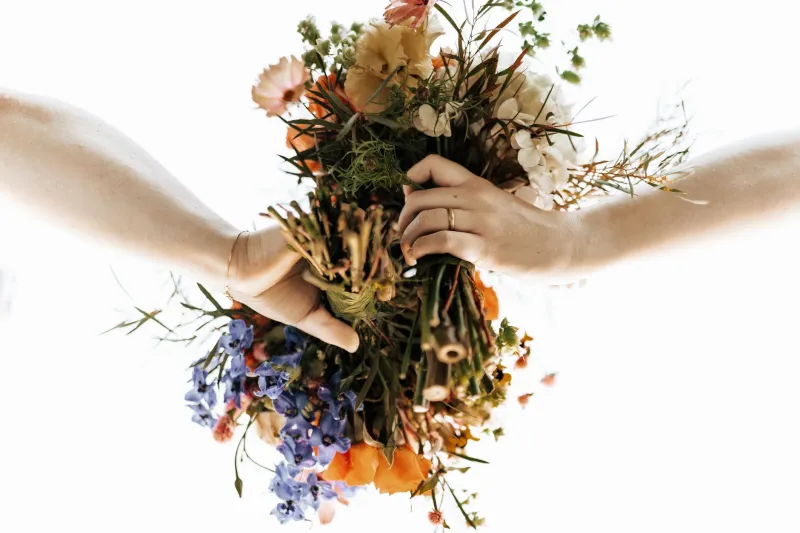
If I could do that Tuesday over, I'd skip the florist near the office and drive to the weekend farmers market vendor my partner loves. I'd pick up a loose bundle of whatever was freshest — probably something in soft peach or lilac, colors that feel easy rather than charged. Maybe some eucalyptus tucked in because they like the way it smells. Nothing wrapped in cellophane. Just flowers in hand, slightly imperfect, clearly chosen.
And I'd walk in without expecting them to do all the talking.
The best apology flowers aren't the ones that say I'm sorry the loudest. They're the ones that say I know you — and then leave room for everything that needs to come after.
That's the kind of story worth telling with petals.